

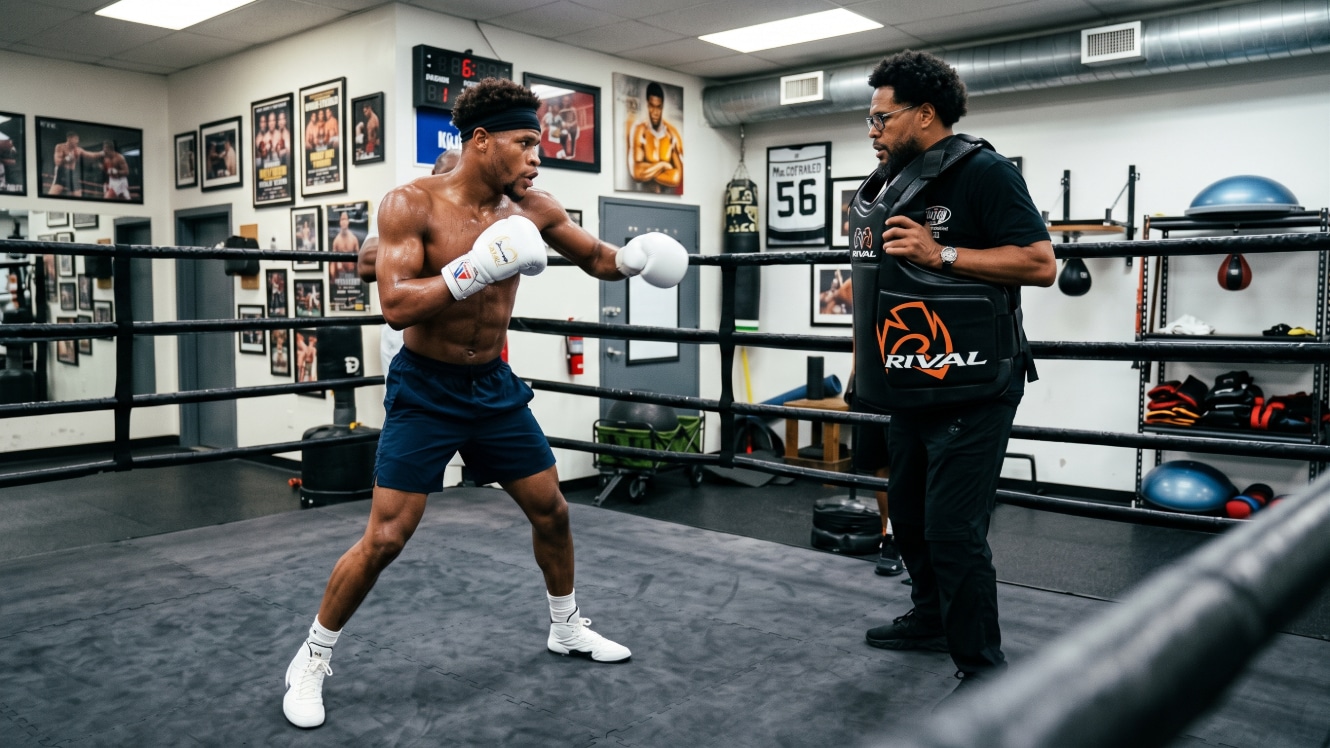
James Toney expects Devin Haney to knock out Liam Paro, but that forecast demands a style Haney abandoned long ago. At 27, Haney has collected world titles for seven consecutive years without a single stoppage victory. Transforming into a finisher against a gritty southpaw means embracing the precise physical exposure his entire system is engineered to avoid.
Toney’s endorsement carries weight after their recent work together in the gym. When asked about the matchup, the Hall of Famer did not mince words.
“You see power. He knock him out,” Toney said to Fighthype.
Gym mitts, however, tell only part of the story. Training equipment offers a compliant target where a puncher can generate torque with settled feet. Real competition forces a different arithmetic entirely. Ripping a leveraged right hand on the pads comes without the immediate threat of eating a live southpaw right hook over the top.
That reality shapes Haney’s actual punching mechanics. Sitting down on a shot requires planting the back foot and committing hip rotation, anchoring him in place for an extra beat. Mobility has always been Haney’s primary defensive insurance policy. Abandoning that fluid perimeter control to load up on heavier leather would compromise his balance, alter his recovery timing, and accelerate fatigue in the late rounds.
The footwork battle against Paro sharpens those stakes. Securing dominant outside position with the lead left foot creates an angle for Haney’s straight right. At the same time, stepping outside is never risk-free. If Haney overreaches to establish that angle or lingers to admire his work, Paro can easily pivot and fire a short counter left down the pipe. For Haney, a clean exit after throwing matters far more than maximum thud.
His 2023 performance against Regis Prograis proved that distinction clearly. Haney dropped the heavy-hitting southpaw with a laser straight right in round three. Instead of swarming to produce a finish, he collected the points, reset the perimeter, and coasted to a wide decision win. A knockdown proved his timing, but it did not change his operational instincts.
Stopping Paro demands sustained combinations. Scoring with a lead punch is simple enough; staying in range to deliver the second, third, and fourth punches is where the peril starts. Paro proved against Subriel Matias that he knows how to survive inside exchanges. He smothered Matias’s offense with smart lateral movement, timely clinches, and sharp counter bursts. If Matias could not break Paro’s defensive resolve on the ropes, Haney will hardly do it with one-off punches.
Toney spent his career thriving in the pocket, rolling with shots on the inside, and returning venomous fire at close range. It makes sense that he sees the game through that aggressive lens. Haney, by contrast, treats close-range trades as an avoidable liability.
Haney might possess sufficient force to stun opponents, but producing an actual stoppage requires living in the pocket. Until Haney shows a genuine appetite for sustained infighting, Toney’s knockout prediction remains completely detached from the fighter Haney chooses to be.
